Thursday, May 29, 2014

Switzerland, Germany, and Miniatur Wunderland

Dear Family and Friends,

Tuesday the 20 of May, was my last day of school at Agora Sant Cugat. At the end of the day I shared the cookies my mother and I made and all the kids signed a t-shirt that I brought. On the previous Friday I had a party with kids in Advanced English. One thing I will remember from the school is that we played soccer every day at both recesses unless it was raining. Another thing I will remember is that you had to wear a smock everyday so you didn’t get stuff on your shirt.
Going away party in Travis' Advanced English class


Catalonia vs. California volleyball tournament our last weekend in Barcelona with our wonderful host Josep Maria Espelta and his son Marti.
On Wednesday, 21 May we flew from Barcelona to Geneva and then my dad and I took 3 trains from Geneva to Lauterbrunnen, while my mom went to a meeting somewhere else (Note from Karen - I met with people at the International Union for the Conservation of Nature about their forest landscape restoration program). From Lauterbrunnen we could see the mountains Monch ("Monk"), Eiger ("Ogre"), and Jungfrau ("Young Girl"). In Lauterbrunnen we could see a waterfall that changed with the wind. The valley in which Lauterbrunnen sits was formed by a glacier so it was a U shape, unlike a river valley which is a V shape.  After arriving in Lauterbrunnen my dad and I went up a mountain train to a town higher up (Wengen). The next day we went on a long hike and we had amazing views of the mountains Monch, Jungfrau, and the Eiger. After the hike we took two trains from Lauterbrunnen to Zürich. We then had dinner with a friend of my parents and took an overnight train from Zürich to Berlin.

Panorama of our hike in the Alps
The next day we took a walking tour of Berlin, saw many historic buildings and remnants of the Berlin Wall, and learned a lot of German history.  One place I found interesting was Gendarme Platz.  Frederick the Great ruled Prussia during the 30 year war. Prussia was the German empire in the 1700s and 1800s. After the 30 year war Frederick the Great realized that he had lost over half his population, so he recruited the French Protestants (Huguenots) that were pushed out of France because of their religion. He invited 5,000 of them to Berlin and built a cathedral for the French, but at the same time they were building a cathedral for the Germans. In the usual one-up fashion the German’s cathedral was 1 foot taller that the French’s. Later in the day we went to a memorial that was a bunch of stone pillars to commemorate the Jews that died in the Holocaust. The next day we went and saw some of the Berlin Wall that still remains and has interesting murals. After that we took a boat up the Spree River to the Checkpoint Charlie Museum. Checkpoint Charlie was a checkpoint between East and West Berlin. At the museum we learned about the different stories of people who tried to escape from East to West Berlin. 

We also learned that Russia wanted all of Berlin to itself so it blocked transport of goods on all the roads, water ways, and railroad tracks. That left only the air. So for 10 months (in 1948 and 1949) around the clock a U.S. or Great Britain plane was landing every 3 minutes to supply all the resources that West Berlin needed. When the Soviets finally ended the blockade the words painted on busses were “Hooray! We survived!”

A few reflections from Karen – I spent winter quarter of my junior year in college, which was the year before the Wall went down, in Berlin. So, Berlin was at the top of my list of places to visit while we were in Europe and the visit left a strong impression on me.  In 1988, West Berlin was much like any major European city except that it was surrounded by a wall, East German guards, and the death strip (area behind the wall where nobody was allowed to be).  When we crossed into the former East Berlin (where most of the historic buildings are) the police closely checked our visa, the building architecture changed to the typical Soviet cement-block buildings, and we knew that we were being closely watched.  Today there is little evidence of the wall except a few memorial sections and a line on the ground where the Wall used to be.  I struggled to remember and explain to Travis and Michael what it was like 26 years ago, as the traffic whizzed by and people sat outside in cafes where the Wall used to be.  We visited the East Side Gallery where there is a 1.3 km section left with numerous murals and the Berlin Wall Memorial where they have diagrams and an excellent outdoors display of what the wall, guard towers and death strip looked like.  They also had an interesting exhibit in the subway station about the “ghost stations” that were abandoned subway stations at the border of the city, which provided a possibility for underground escape. I was struck by all the rebuilding throughout Berlin and Leipzig (where I spent 3 days at a scientific working group), as a result of damage that hadn’t been repaired from the bombing during WWII and to modernize things since the East German era. As I tell my students, to me my experience in Berlin then and now will always be the most graphic illustration to me that major change can happen.
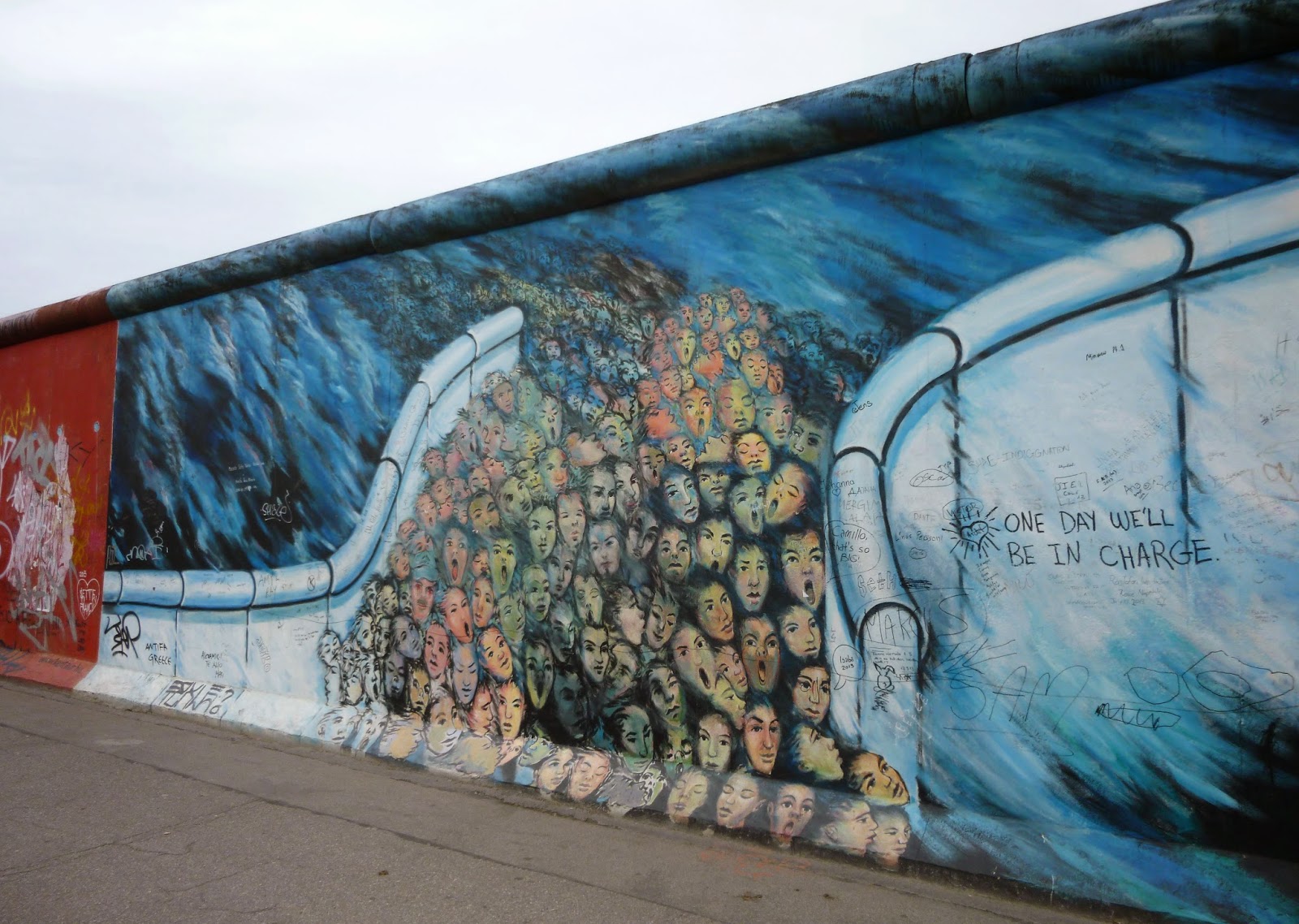
Mural on one of the few remaining sections of the wall

Line of stones on the street show the former path of the wall.
Back to Travis writing - The next day we went to Potsdam and rented bikes and audio guides. Potsdam is about 45 minutes by train from downtown Berlin.  It was where the kings from Prussia had their palaces. There were 7 palaces. Most of them were built in the 17 and 18 hundreds. (Michael: One of the cool things we saw was the building where the Potsdam Conference was held after World War II.)  The weather was beautiful and the entire day was very relaxing. 
Biking around Potsdam
Monday, 26 May my mother went to a science meeting and my father and I went to Miniatur Wunderland in Hamburg. Miniatur Wunderland is the world’s largest model railroad. It also has the world’s smallest airport. They have 8 sections and the first section we went to was Switzerland. In Switzerland they had the Matterhorn and it was 6 meters (not feet) tall. They also had a concert and you could press a button so that the band would start playing music. There was another button that would power a chocolate factory that would give you a piece of real chocolate. The next section was Knuffingen Airport. The airport is the Hamburg Airport but with a different name. Most of the planes take off and land at the airport.  Some of them are always at the airport and never take off and land. They use magnets to move the planes around the airport. When the plane is on the runway two rods attach themselves to the belly of the plane and lift up as the plane takes off. They also have all the different airport vehicles that move around the airport. At one point a fake fire started on a parked plane and the entire fire brigade raced to put it out. All the flights were delayed because the space shuttle landed. They also had a bee fly by with a bunch of people riding it.

The next section was the fake town of Knuffingen. The reason it’s called Knuffingen is because one of the workers didn’t see his wife a lot when they were making the first part. So to make it up to her he called the town Knuffingen, her nickname. In Knuffingen the trucks actually drive themselves. Every once in a while a fake fire starts and the fire brigade goes and puts it out. The section after Knuffingen was Austria. In Austria there was a ski resort that had actual working ski lifts. There were also about 200 naked people hiking up a glacier (If you don’t believe us we will send you the photo). There was also a funicular (if you don’t know what it is look it up in a dictionary) that you press a button and it goes up the mountain.

The next section was Middle Germany. In Middle Germany there was a big fair that had a bunch of rides that you could press a button and the rides would start up. At night time all the rides had really cool lights that lit up. There are approximately 30,000 lights on the fair alone. You could also watch the people in the control room. My dad made the comment “Here you have 7 Hyper-caffeinated guys.” because there were a ton of coffee cups, Redbulls, and coca cola bottles. The next section was Hamburg. In Hamburg there was a construction site that had actual moving cranes. There was a very big train station that had a lot of detail. They had an intercity train that stopped at each different station and waited for the next one to come. They also had a recreation of the Hamburg soccer stadium that has 12,500 figurines. At night you can see a bunch of camera lights flashing. They also have a recreation of the opera house. And when you press the button it opens up and you could see all the tiny orchestra members playing an instrument.

The next section was America. In America you could see redwoods, Las Vegas, Grand Canyon, Half Dome, Mount Rushmore, Cape Canaveral, Miami, and Key West. So you get the point....they tried to cram as much of the United States in one section as possible. In Cape Canaveral you could press a button and the Space Shuttle would go up a string and then come back down. The last section was Scandinavia. In Scandinavia they had boats that were actually moving; the tide also ebbs. There was also a pack of reindeer that was led by Rudolph, although his nose only lights up between December 1st and January 6th. And if you want to see a cool, 5 min. video about Miniature Wunderland click here.

The world-famous (if you're a model train geek) Knuffigen Airport, complete with Arrivals and Departure screen that shows which model plane will take off or land next, with the correct time!
Part of the city of Hamburg, in miniature.

The Swiss Alps at Miniatur Wunderland
And a final paragraph from Michael - After our adventures in Miniatur Wunderland, Travis and I took yet another train (this time a real one) to Bayreuth to visit colleagues Anke Jektsch and Carl Beierkuhnlein.  We spent two days there where I gave a talk, visited their facilities and field experiments, and met various postdocs and students.  We are now in southern Bavaria where we will see some of the sights of Munich and hike in the northern Alps. And, in less than a week we will be on our way back to Santa Cruz.

Travis, Michael, and Karen

Wednesday, April 23, 2014

Paris, London & Oxford

Dear Friends,

Over our spring break from school we went to France and England. We spent the first weekend in Paris. On Saturday we took a walking tour. At the end of the tour we could look in a 360° angle and see 5 important landmarks and buildings which included the Eiffel Tower, Place de la Concorde and the Egyptian obelisk that is in Paris. After the tour we took a boat tour on the Seine River which runs through the center of Paris. From the river we could see the Louvre, Notre Dame, and the Eiffel Tower. The boat went under a lot of bridges. The following day we went to the most famous art museum in the world, The Louvre, where we saw the Mona Lisa, a mummy and big statues of Sphinxes. After we went to the Louvre we went to Luxembourg Park and rented toy sail boats that you could push across the small pond there.

Sailboats in Luxembourg Gardens - Travis' is on the right
The next day we went to the most famous landmark in Paris: The Eiffel Tower. When we got to The Eiffel Tower we were glad we had bought tickets online because there were at least 200 people in each of the 2 lines. From the top of The Eiffel tower we could see all of Paris. Then we went to Notre Dame, which is a cathedral that was built in 1345. In the late afternoon, we went on a high speed rail train to England that went under the English Channel in a tunnel (the Chunnel). The trip wasn’t as exciting as we had anticipated. My mom thought there was going to be an announcement that we were going down into the Chunnel (She also thought there should have been little plastic fishes on the wall like at Disneyland, but it was just dark like all tunnels).

Views from the bottom and top of the Eiffel Tower.  The most well-traveled giraffe joins us for the trip.

In London, we went to Westminster Abbey, which is a massive cathedral where kings and queens are crowned and buried. Also many famous people get buried in Westminster Abbey. I got to walk on Charles Darwin’s grave. My dad really wanted to find all the important scientists graves.  Next we saw the Changing of the Guards at Buckingham Palace. Buckingham Palace gardens were very pretty but it looked like the palace itself could use a washing.  After lunch we walked to Primrose Hill and we got a view of London.  Then we went to the British Museum. On Wednesday my dad and I did the touristy thing of riding the sightseeing bus. We got off at the bus stop for Tower Bridge. My dad and I went up 200 stairs (you could take the elevator) to the top of Tower Bridge. There was an interesting museum about some of the most famous bridges in the world, such as The Golden Gate Bridge. After my dad and I met my mum (as English people say it) and we saw Mamma Mia, which is a musical with many ABBA songs and flamboyant costumes. On Thursday we went to Kew (pronounced Q) which is the Royal Botanical Gardens. We saw cacti in the Royal Botanical Gardens and at one point a guard came by to make sure my dad was not stealing any cacti.

Beautiful flowers and lots of people at Buckingham Palace

We spent our last couple days in Oxford which is about an hour northwest of London. On Saturday we went hiking with some of my dad’s friends and I played with their kid Alex who is 7 years old.  We also saw some rocks that were placed in a circle by Neolithic people around 3,500 B.C. The rocks looked sort of like a small Stonehenge. On Sunday we met some other friends and walked around the grounds of a palace. I played with their 3-year old son Alan and we walked through a cool maze made of tall shrubs.

Alex and Travis read up on the World Cup teams

Travis catches Alan before he escapes

A few comments from Karen – One of the high points of the trip for me was meeting up with scientific colleagues at Kew.  We stayed with Bruce Pavlik, who I know from restoration work in California and is now the head of Restoration Ecology at Kew.  I spent a couple of days meeting with various scientists at Kew who are doing research on the ecology of tropical forest trees to use for reforestation in Africa, Asia, and Latin America.  I visited the Millenium Seed Bank where Kew has already stored seeds of 64,000 species of plants (and they continue to add species) to serve as a reserve in case the plants become extinct in the wild; it’s an impressive operation and facility.  Besides science, we were also pleased to be able to meet up with Ole Rummel, a friend from college, and David Goodman, a retired faculty colleague from UCSC.  

And the last word from Michael – I was really amazed by the amount and diversity of items in The Louvre.  I have never really considered myself a huge afficianado of sculpture, but there were some items there that were fascinating. For example, the Roman-era piece "Diana the Hunter" had this amazingly flowing quality to it.  La Jaconde (the Mona Lisa) was somewhat anticlimatic; I was much more taken with the painting The Coronation of the Emporer Napoleon I (in which he is crowing Josephine and himself in Notre Dame Cathedral) as well as The Wedding Feast at Cana. I have to admit that it was pretty cool to hear the bells of Big Ben, see the monuments in Westminster Abbey, and to cross the Tower Bridge in London. One of the personal highlights for me was being able to spend time in the cactus section of the herbarium at Kew and pouring over all the old specimens, as well as seeing the research succulent collection. 

One of Michael's MANY cactus photos (genus Melocactus for those who are wondering.  The brownish structures are their flowering stalks!)


We had a great time catching up with Andrew Smith and his family (wife Fran and son Alex) in Oxford. Andrew and I know each other from when I was a graduate student at UCLA; we spent a lot of time talking about the evolution and biochemistry of desert plants. He took us on a tour of Magdalen College, one of 38 colleges at Oxford and where Andrew is a tutor.  It has an impressive chapel (built in 1474) that rivals many European churches and a few noteworthy graduates include Oscar Wilder, Henry VIIIth, and Dudley Moore.  We were also able to meet up with my good friend and colleague Lisa (Patrick) Bentley, her husband Topher, and son Alan.  Lisa is doing a postdoc at Oxford, and we spent a perfectly relaxing Sunday at Blenheim Palace walking around, chatting, and watching the boys have a fun time. 

Cheers - Travis, Karen, and Michael

Sunday, April 6, 2014

a few more thoughts on life in Spain

Dear Friends and Family,

We’ve spent the better part of the last three months outside of Barcelona and thought we’d each write a little bit on a few of our impressions/experiences here (this is Karen writing now).  During the week Michael and I have been working (research, writing, grant proposals, lots of Skype calls with colleagues & graduate students, etc.) and Travis has been going to school.  On weekends Travis has soccer games on Saturday mornings (so that hasn’t changed) and then we’ve been doing various local outings.  I have given several seminars at various Universities in Spain which has given me an opportunity to also visit some habitat restoration field sites.  Spring is approaching and the trees have leafed out here.  Michael and I have been enjoying being able to bike 30 min. to the University all with dedicated bike paths (quite a change from our bike commute route in Santa Cruz). We also appreciate how easy it is to get around by foot and public transit here.  

As any of you who have traveled in Europe know one of the things that is most striking is the difference is the ages of the buildings.  A couple weekends ago we were attending a calçotada, a uniquely Catalonian social event, where people eat large quantities of green onions roasted on an open fire (calçotes) and served with a tomato-based sauce and other food, and drink wine.  The event was held at a farm of the family of one of the graduate students in the department where we are based; the farm had been owned by the same family since the 13th century!

Calcotada - onions on fire and Michael demonstrates proper calçotada eating technique with mandatory bib


Another weekend we were hiking at the Costa Brava which is an hour and a half northeast of where we are based and along the coast.  We were hiking through some hills with a view of the Mediterranean on one side and the snow-covered Pyrenees Mountains on the other.  The vegetation looked much like coastal scrub in California (always fun to see examples of convergent evolution) with many of the same plant genera (for the plant nerds reading this - e.g. Quercus, Mimulus, Rubus, various brooms in their native habitat).  One big difference as we were hiking, however, was that we came across ruins of churches and fortresses, and a monastery dating back a thousand years.  The day before we had visited a site with both ruins of the Greeks (~200 BC-100 AD) and the Romans (~100-400 AD).

Costa Brava - Greek ruins at Empuries (above) and view of monastery and coast from hike (below)(photos courtesy of the Spanish tourism department - we accidentally left our camera at home)


But, we haven’t just seen old buildings.  Yesterday we finally made it to the La Sagrada Familia church designed by Gaudi.  Construction was started in the late 1800s but it’s definitely still a “work in progress” (with three cranes and much scaffolding on the site) and isn’t slated to be completed until 2026.  I had just hit the point of “I’m not sure I can visit another church” as we've seen so many.  It is, however, a truly amazing structure both respect to the size (designed to hold 13000 people and rising ultimately to a height of 170 m) and the level of detail both inside and out.

La Sagrada familia - exterior and interior ceiling (looking upward, below) - photos courtesy of Wikipedia (ours didn't really do it justice)


Michael writing now - For me, one of the most amazing things has been the time scale of things here.  In North America we have amazing spatial scales in our deserts, prairies, and mountains (which I suspect may be one reason why German tourists are often in awe of the desert vistas of the US southwest.)  Here, I have been constantly amazed by the age of buildings, monuments, art, and other things that date back to the Middle Ages, or Roman times, or even earlier (such as the Greek ruins at Empurias that Karen mentioned above).  I have taken to touching (whenever or wherever possible) old columns, walls, stones, etc. and try to think about the nameless and faceless worker who placed the stone in the wall, and when.  I have been wondering about questions such as “How many rainstorms has this wall experienced?  How many people have walked by this church over the ages?  How long will this column last? Has this place where I am currently standing really been sacked by legions of Romans, boatloads of Vikings, and marauding Visigoths?”

In high school I took a history class in which we learned about Greek and Roman times which included some architecture (things such as the differences between Doric and Corinthian columns.) I enjoyed the history but was only slightly interested in the architecture.  This trip has started me thinking much more about architecture and how certain structures were designed and built, particularly given the lack of “modern” methods for transporting, lifting, and cementing large stones in place. The aqueduct in Segovia, Spain was really eye-opening in this respect.  The aqueduct is huge (813 meters long), tall (~30 m tall), and contains 88 arches. It was built in the 1st century AD, and it still stands, despite being held together entirely by gravity.  The ingenuity that went into building something that massive and that has stood the test of time is truly mind-boggling to me. How did they figure it out?  How did they transport the stones, and lift them into place?  How did they stabilize arches or tall walls while under construction? Before we traveled to Spain, we saw a documentary on TV that showed the engineering that underlies load-bearing in tall, narrow arches in cathedrals, and how flying buttresses work to maintain the forces bearing downward on their walls (and not out, which would cause the walls to bow out and collapse.) So, perhaps part of what amazes me is that the science and engineering was done without our slide rules, calculators, or computer models. Likewise, the architecture in Morocco amazed me for the Islamic influences, the lack of figures (human and animal), and the preponderance and similarity and yet variation of geometric shapes and patterns. And, trying to imagine the time and skill required to attain the level of detail and workmanship still causes me to wonder how it was all done and how long it must have taken. P.S. I now know the difference between a Romanesque and Gothic arch! 

Now Travis’ turn - A few weeks ago we went to a Barcelona (Barça) soccer game. Being the Loik-Holl family we arrived to the game 1.5 hours early. The stadium in Barcelona fits just over 100,000 people inside. The day we went there were 67,000 fans at the game because the team they were playing was a team that was in the middle of the league. It was raining the whole game, but we were lucky and had seats under the overhang. Barcelona won the game 3-0 but their goalie got injured in the first half, which means Spain’s national team is without their starting goalie.  They will be without their starting goalie for the World Cup, so they may not be as good.

Barca vs. Celta de Vigo.  

Some things that are different at my school in Spain are: first, every Friday we get on a bus and go swimming for 35 minutes. The second thing that is different is that the school has sports teams for elementary grades. I am on the school soccer team and we won yesterday. Another thing that is different is that the school is trilingual so some classes are in Catalan, some are in Spanish, and some are in English. One other thing is you must learn French or German. Another thing that is different is that the teachers come to our classes. Instead of having one teacher we have multiple teachers. The final thing is everybody has to play a musical instrument.

(All of us) We have two more months here left (boy time flies) and have a couple trips planned before we return to the US in early June.  Despite our adventures here we are looking forward to seeing everybody and our pets when we get back.

Karen, Michael, and Travis

Thursday, March 13, 2014

Morocco

Dear Family and Friends,
We spent the past 9 days in Morocco, which is a country in the northwest of Africa just south of Spain. It is approximately 446,550 km2 in area, which is about the size of California. The population is 33 million. In Morocco the official language is Arabic and many people speak one of the three types of Berber and/or French.  Some younger people also speak English.

Present day Morocco has been inhabited by humans for at least 160,000 years. Morocco was one of the first places evidence of Homo sapiens was found.  The Berbers (one of the earliest ethnic groups in Morocco) and the Saami people from Scandinavia are closely related, which suggests early hunters and gatherers from Spain and France colonized these areas after the last ice age. The Romans ruled the area from approximately 146 B.C. to 250 A.D. The Arabs and Islam arrived in Morocco in 622 A.D.  Between 800-1850 there were lots of dynasties and wars so there were a lot of fortresses built, and we saw a bunch of them. The strongest of those dynasties controlled parts of southern Spain. From 1850-1950 Spain and France ruled parts of Morocco. Morocco got independence in 1956.

99% of Moroccans are Muslim.  Muslims are expected to pray five times a day, so there were a lot of mosques.  Muslims can’t have pictures of Allah (god), animals, and people so they decorate the mosques with mosaics of plants and stars. During Ramadan (holy month), Muslims do not eat, drink, or smoke during the daytime.  Most women wear head scarves so that men besides their husband can’t see them and for a long time women were not educated.  Women’s rights have become more equal recently.  Education only became mandatory 10 years ago.

The flag of Morocco is shown below. The green represents hope, love, joy and is the color of Islam. The red stands for bravery, valor, strength, and hardiness. 


Map of our travels through Morocco
The first day we arrived in Fez, Morocco and took a walking tour of the city. Fez feels like a maze when you are walking through the medina (old part of the city with a wall around it). They use donkeys and mules to transport goods because the streets are so narrow (often less than 5 feet wide). There are very few windows on the outside of houses as the buildings face inward to a central courtyard. There are 500 mosques in the medina and we saw a few. Non-Muslims cannot go into mosques unless they are no longer used. We visited the last manual tannery, which is located in Fez.  The tannery was founded in the 12th century. It takes three weeks for one leather skin to be dyed and then dried. They use natural dyes to dye the leather. We saw artists who make fancy woodwork and who hand sew the robes people wear. I saw 33 cats on the first day (we hardly see any in Sant Cugat), but there were no dogs because people think they kick up angels.


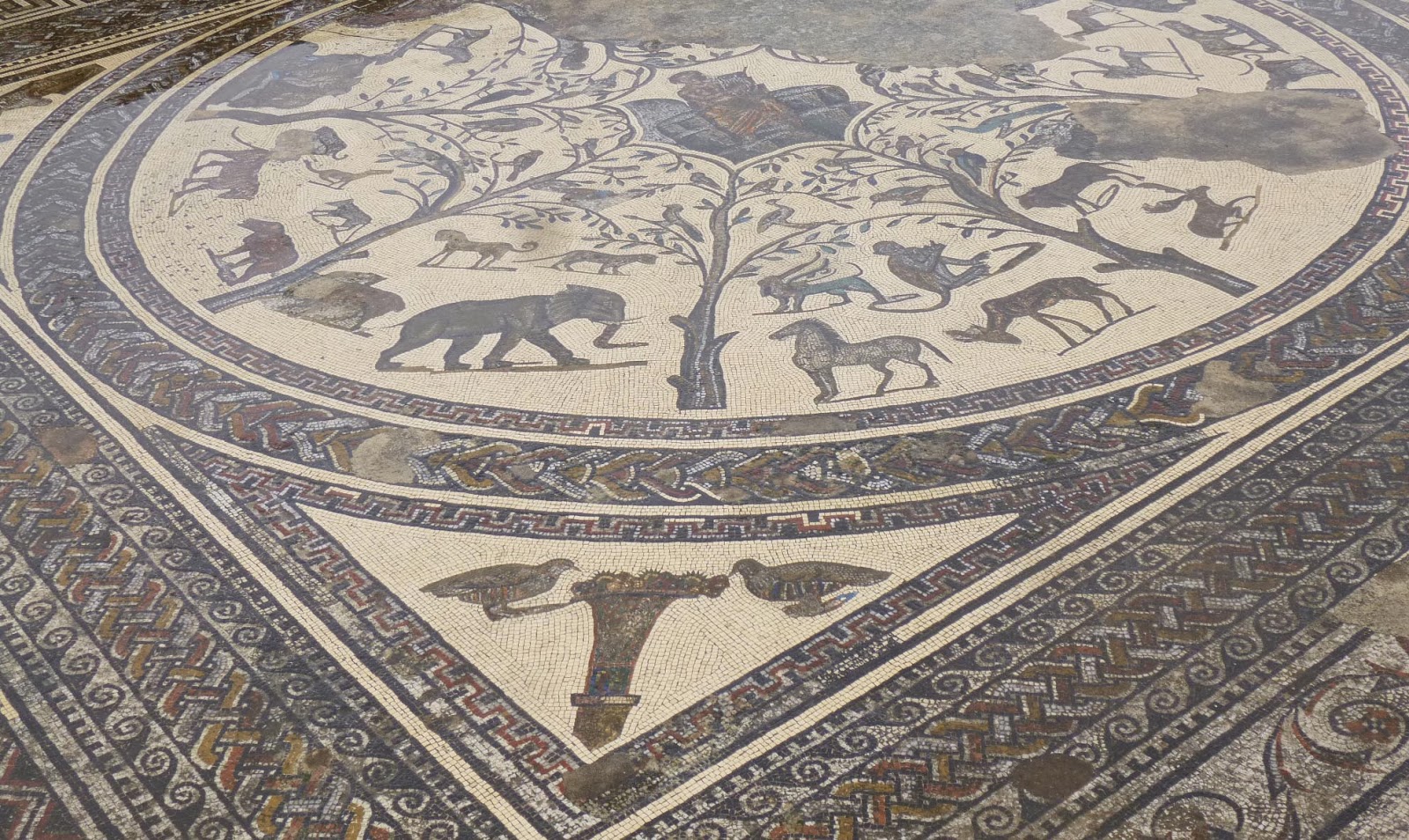
On the second day we visited Volubilis which is a city that is left from when the Romans ruled. 15,000 people lived in Volubilis during the Roman era. In Volubilis we saw mosaics that were 2,000 years old and still intact.  In Meknes (a city near Fez) we went into a former mosque and a granary.  We also saw them pounding silver thread into metal to make jewelry. 


The intricate mosaics, stucco, and wood painting typical of the many mosques we visited.

One of the 2000-yr old floor mosaics at Volubilis
On the third day we drove 7 hours up and over the middle Atlas Mountains which are a mix of steppe meadows and dry forest, which is dominated by oaks, cedars, junipers, and pines. The Atlas Mountains are located in Algeria, Morocco, and Tunisia and are 2,400 miles long.  In the mountains we saw Barbary apes, which were very tame, and I fed some of them (other people were doing it too).  We went through the high steppes that had snow and I was the first person from my family to throw a snowball in Africa. We saw lots of feral sheepdogs along the road; they wait for tourist buses and try to get free food. We followed a desert river where they grow dates.  In Morocco they grow over 25 kinds of dates.

At the end of the day, we got to the edge of the Sahara Desert, where we climbed up some of the smaller dunes which was fun because where I live there are small dunes, but you can’t climb up them. The Sahara Desert takes up 10% of Africa. 25% of the Sahara Desert is dunes, and some dunes can get up to 500 ft. The Sahara Desert is the 3rd largest desert in the world after Antarctica, and the Arctic. The annual rainfall is about 2.5 cm a year.
Barbary ape in Atlas Mountains

Panorama of landscape in Middle Atlas mountains ~2000 m

Panorama of landscape typical east of Atlas Mountains at edge of desert along a riparian oasis.
The next day we went to a small town and heard Berber music. Then we went to the site of old lead mines. After that, we went to a house of a nomad which was by itself in the middle of the desert (see photo). Their house is more like a few tents than an actual house. We played soccer with the nomad kid that lived there. He was 7 years old and doesn’t go to school and doesn’t get to play with other children (besides visitors) because there are only a few other tents nearby and there aren’t any other children.

In the late afternoon we rode camels to a camp in the middle of the dunes. When we got there we climbed up a giant dune to watch the sunset. That night after dinner, we hung out round the fire and we learned how to drum with our Berber hosts. We woke up early in the morning to climb up the dune and watch the sunrise. Then we came back on the camels and drove to first to Todra Gorge and then to Dades Gorge, which are canyons in the desert. Then we walked along the river in Dades Gorge and looked at the crops. The next day we visited old towns and fortresses where they filmed Hollywood movies such as Lawrence of Arabia. 

Playing soccer at nomad house in middle of the desert

Giraffe and Travis on camel ride

Dunes at sunset.  

Travis gets training so he can go play on West Cliff

Ait Benhaddou - one of the many kasbahs (fortresses) from the 10th-14th centuries 
We drove back over the High Atlas Mountains towards Marrakech and saw lots of amazing scenery.  We went over a pass that was 2200 m.  At the bottom we saw how women processed Argon nuts (which are nuts kind of like almonds), to make soaps, lotions, cosmetics, and butter (kind of like peanut butter). Then we arrived in Marrakech where we went to the main square. The main square had lots of different shops and crafts. My dad got a picture with the snake charmers. There were also a lot of orange/lemonade/grape juice stands.

In Marrakesh we visited more mosques and the large market where they sell many things such as, tassels, rugs, magic boxes, spices, and rugs.  We went to a place where they made dyes for wool, cotton, and cactus silk. After that we went to Jardin Majorelle (a garden). The garden had mostly succulent plants in it. The last day we went to a cooking class where we learned how to make Moroccan soup, vegetarian and lamb tagine (the national dish of Morocco, kind of like a casserole), and Moroccan bread. The food was very good.

Total cat count for trip: 129
Total dog count trip: 112
CATS WIN!


Travis (writer), Karen (photos and editor), Michael (maps & birthday boy - March 12)

P.S. If you can't see the details in the photos, you can click on them and they will enlarge.

Travis and Moroccan women shelling and grinding argonne nuts


Michael was very excited to see the snake charmers in Jemaa el Fna (the main square in Marrakech)

Spices in market

Travis models desert wear in front of natural dyes

Moroccan cooking extravaganza

Monday, February 10, 2014

Andorra & Madrid

Dear Family and Friends,

Three weekends ago we went to Andorra. Andorra is a small country wedged between France and Spain. In Andorra you can drive from one end of the country to the other end of the country in 45 minutes. There are no train tracks. There are seven big towns. Andorra is the 16th smallest country in the world.  It is 468 sq. miles and has a population of 85,000 people; Santa Cruz COUNTY is about three times bigger in size and population.  Andorra is in the Pyrenees Mountains. The average elevation of the country is 6,549 feet (just over a mile tall) and ranges from 2,756 feet to 9,652 feet so there are some tall mountains turning into very steep valleys. The scenery was spectacular the second day.  We couldn’t see the mountains the first day because it was snowing, but we saw a rainbow (it was special because it was created between snow and sun) (also because it was a double rainbowJ. What does it mean?! (Inside joke)).

While we were in Andorra we went to a ski resort called Naturlandia. It had a roller coaster /slide (the Tobo-Tronc) which is 3.5 kilometers long (to see it go to the link here). It was so fast. It was so long at the top there was all snow and at the bottom there was almost no snow. We also went zip lining, snow shoeing, cross country skiing, sledding, and snow tubing.

View of the mountains in Andorra
Cross country skiing in Andorra

Last weekend we went to Camp Nou (pronounce no). Camp Nou is where Barcelona Football Club plays. Barcelona has won four UEFA (Union of European Football Associations) League championships, is more than 100 years old, and has at least 150 trophies. They have 173,000 members. The stadium is the second largest soccer stadium in the world. Barcelona FC also has handball, roller hockey, indoor soccer, and basketball.

Camp Nou (Barcelona soccer stadium).  Plant nerds out there...my dad would like you to notice the turf light structures that he wants to get for his next experiment.
This past weekend we went to Madrid and to some surrounding towns. On Friday we took the high speed rail from Barcelona to Madrid. It took us two and a half hours to get there and we stopped at one station along the way. At one point the train was going 300 kilometers per hour (186 mph). Then once we arrived we went to the Royal Palace. The Royal Palace is the official residence of the royal family but is only used for ceremonies. It was built in 1755. In the Royal Palace there was a room where everything was covered in gold. Every many of the royal family has many rooms including a separate room for each person to eat lunch.  There was also an armory that had a gun that was 15 feet long. In the armory there was also armor for children.

Royal Palace
The next day we went to a town north of Madrid called Ávila, which is a town that has a wall all around the city. We got to walk on the wall. We heard a story about one time the army left and an enemy came trying to capture the city so the women took cooking utensils and torches to make noise so that the enemy thought the army was still there. Then later we went to another town called Segovia. In Segovia there was an aqueduct that was built 2000 years ago by the Romans to and is still standing. The romans used the aqueduct to transport water. They didn’t use any mortar to build the aqueduct and it had 167 arches. We also went to the alcazar (fortress) in Segovia where in the olden days they dropped boiling oil on trespassers heads.
Wall around Avila
Aqueduct in Segovia
Armor in Segovia Alcazar

On Sunday we went to Toledo, south of Madrid. Toledo is a town built on a hill for protection. It also has a natural river running around it on 3 sides which was helped with protection from attacks. In Toledo they are known for making swords and there are a lot of sword shops. One shop had a remake of Bilbo Baggins’ sword which cost 188 Euros (~$250).

Travis

View of city of Toledo, Spain (not Ohio)

Window of one of the many sword stores in Toledo

Sunday, January 19, 2014

Sant Cugat, Barcelona, Spain

Dear Friends and Family,

On January 9 we arrived in Spain. We are living in a small apartment in Sant Cugat.  It takes us 20 minutes by train to get to Barcelona unlike when we were in Richmond (Australia) where it took us 1.5 hours to get to Sydney which is nice because it doesn't take so long. Where we live in Spain you can walk a kilometer and do all your shopping and activities, which is unlike when we lived in Australia. There is even a grocery store in our apartment complex.

We are in Catalonia which is a part of Spain. People in Catalonia speak their own language which is Catalan. Many Catalonians want their own country and people fly the flag of Catalonia (the state flag). At my school we have classes in three languages: English, Spanish, and Catalan.  We also have to take another language: French or German.  The other day we had French and I understood absolutely nothing.  I can understand a little bit of Catalan, because it is kind of like Spanish. At my school I met a bunch of people and have made a lot of friends. At my school we play soccer every recess (just like in Australia).  There is also a school soccer team that I am on.  I have to wear a uniform.  We also have to take an instrument.  

Last weekend we went to the Barcelona History Museum. I learned that when Barcelona was first colonized (approximately 10,000 years ago) about half of present day Barcelona was under water. I also learned that the Romans ruled for a long time and they called it Barcina. In the city of Barcina exhibit I learned how they dyed their clothes, where they cleaned themselves and their clothes, how they made fish sauce, how they kept fish, and how they made wine. They made fish sauce by taking the head and the guts and grinding them up. They kept the fish by catching it and then cutting off the head and the guts for the fish sauce. Then they would put the fish in layers of salt and then they put a final layer of salt so the flies couldn't get to the fish.
We also went and saw an organ concert at the Cathedral of Barcelona. The cathedral and the organ were amazing. They started building the Cathedral in 1298 and it took 150 years.  The organ had around 200 pipes (my dad counted) and is over 600 years old. The concert was an hour long. 

Yesterday we went to the Museum of Mammoths. It was quite small but we learned about sabre toothed tigers, prehistoric rhinos, and musk oxen.  Then we went to the Museum of Chocolate. In the Museum of Chocolate I learned about how chocolate is made. I also learned about how the Aztecs used it as money. The Europeans thought that was crazy because the money was growing on trees. There was also a video of how chocolate became so important. There were also some amazing sculptures (see photo below).  Then we went to the Picasso Museum. It was not as interesting as the chocolate museum of course, but it was still interesting.

For those of you who didn’t see me in California I thought you might want to see the pic of me with my dyed hair for the Denver broncos (football team) who are going to win the superbowl :D (Just saying).
            *You must have a google account to comment on the blog*
Travis :) :D

A few comments from Karen: We’re feeling really fortunate at how easily we’ve settled in here and how well things have worked out, particularly on the housing front.  Arranging housing here from Australia last fall was a challenge.  After responding to several online advertisements and either not getting responses or being told that the owners wanted year-long leases, we thought we were going to have to show up here without housing and find something once we arrived.  So, we were quite relieved when a man kindly took pity on us and offered us a 5-month lease since his sister had a similar problem finding a short-term lease in San Francisco; we put down a deposit after only a “skype tour” of the apartment.  We feel quite fortunate that apartment and the location are working out well for us.  The owner left it well furnished so we only had a few household items to find on our “scavenger hunt” of San Cugat last weekend.

San Cugat is a bustling town of 85,000 people (and a lot of dogs) with everything within close walking distance if you know where to find it.  As Travis mentioned, it is 20 min. by train into Barcelona.  It takes 10 min. in the opposite directly by train to get to the Autonomous University of Barcelona where Michael and I are both being hosted by research colleagues who have been very welcoming.  In addition, over the next few months we will be visiting research colleagues elsewhere in Europe.

Before I left, several people asked me if I was preparing for the Castilian accent, since I speak Central American Spanish.  I’m pleased to say that I have had no difficulty understanding people or vice versa, although like with American and Australian English, there are a number of words that are different.  One thing I have been struck by is the dominance of Catalan (the local language) in the region.  It isn’t an issue for talking with people, since everybody speaks both Spanish and Catalan and responds to me in Spanish.  But, nearly everything is written in Catalan (e.g. the pamphlets on the train ticket pass options and bank account types, store signs).  I can usually make out the gist of text since is closely related to Spanish and French, but we’ve definitely been appreciative of the Google translate function.  The Catalonian independentist movement is quite strong, and I was asked twice in my first weekend here to sign a petition to put a referendum for independence on the ballot.  Fortunately, the people at Travis’ school have been quite accommodating in giving him more Spanish and less Catalan instruction, and he seems to be doing quite fine navigating the mix of the Spanish, Catalan, and a little English on the playground.

Saludos,

Karen   
              my mohawk

 my (rooster) mohawk
in Barcelona. gettting lunch on Avenida Las Ramblas

 my school uniform

 the street we live on

San Cugat with the monastery tower in the background

a sculpture at the  Chocolate Museum