Thursday, March 13, 2014

Morocco

Dear Family and Friends,
We spent the past 9 days in Morocco, which is a country in the northwest of Africa just south of Spain. It is approximately 446,550 km2 in area, which is about the size of California. The population is 33 million. In Morocco the official language is Arabic and many people speak one of the three types of Berber and/or French.  Some younger people also speak English.

Present day Morocco has been inhabited by humans for at least 160,000 years. Morocco was one of the first places evidence of Homo sapiens was found.  The Berbers (one of the earliest ethnic groups in Morocco) and the Saami people from Scandinavia are closely related, which suggests early hunters and gatherers from Spain and France colonized these areas after the last ice age. The Romans ruled the area from approximately 146 B.C. to 250 A.D. The Arabs and Islam arrived in Morocco in 622 A.D.  Between 800-1850 there were lots of dynasties and wars so there were a lot of fortresses built, and we saw a bunch of them. The strongest of those dynasties controlled parts of southern Spain. From 1850-1950 Spain and France ruled parts of Morocco. Morocco got independence in 1956.

99% of Moroccans are Muslim.  Muslims are expected to pray five times a day, so there were a lot of mosques.  Muslims can’t have pictures of Allah (god), animals, and people so they decorate the mosques with mosaics of plants and stars. During Ramadan (holy month), Muslims do not eat, drink, or smoke during the daytime.  Most women wear head scarves so that men besides their husband can’t see them and for a long time women were not educated.  Women’s rights have become more equal recently.  Education only became mandatory 10 years ago.

The flag of Morocco is shown below. The green represents hope, love, joy and is the color of Islam. The red stands for bravery, valor, strength, and hardiness. 


Map of our travels through Morocco
The first day we arrived in Fez, Morocco and took a walking tour of the city. Fez feels like a maze when you are walking through the medina (old part of the city with a wall around it). They use donkeys and mules to transport goods because the streets are so narrow (often less than 5 feet wide). There are very few windows on the outside of houses as the buildings face inward to a central courtyard. There are 500 mosques in the medina and we saw a few. Non-Muslims cannot go into mosques unless they are no longer used. We visited the last manual tannery, which is located in Fez.  The tannery was founded in the 12th century. It takes three weeks for one leather skin to be dyed and then dried. They use natural dyes to dye the leather. We saw artists who make fancy woodwork and who hand sew the robes people wear. I saw 33 cats on the first day (we hardly see any in Sant Cugat), but there were no dogs because people think they kick up angels.


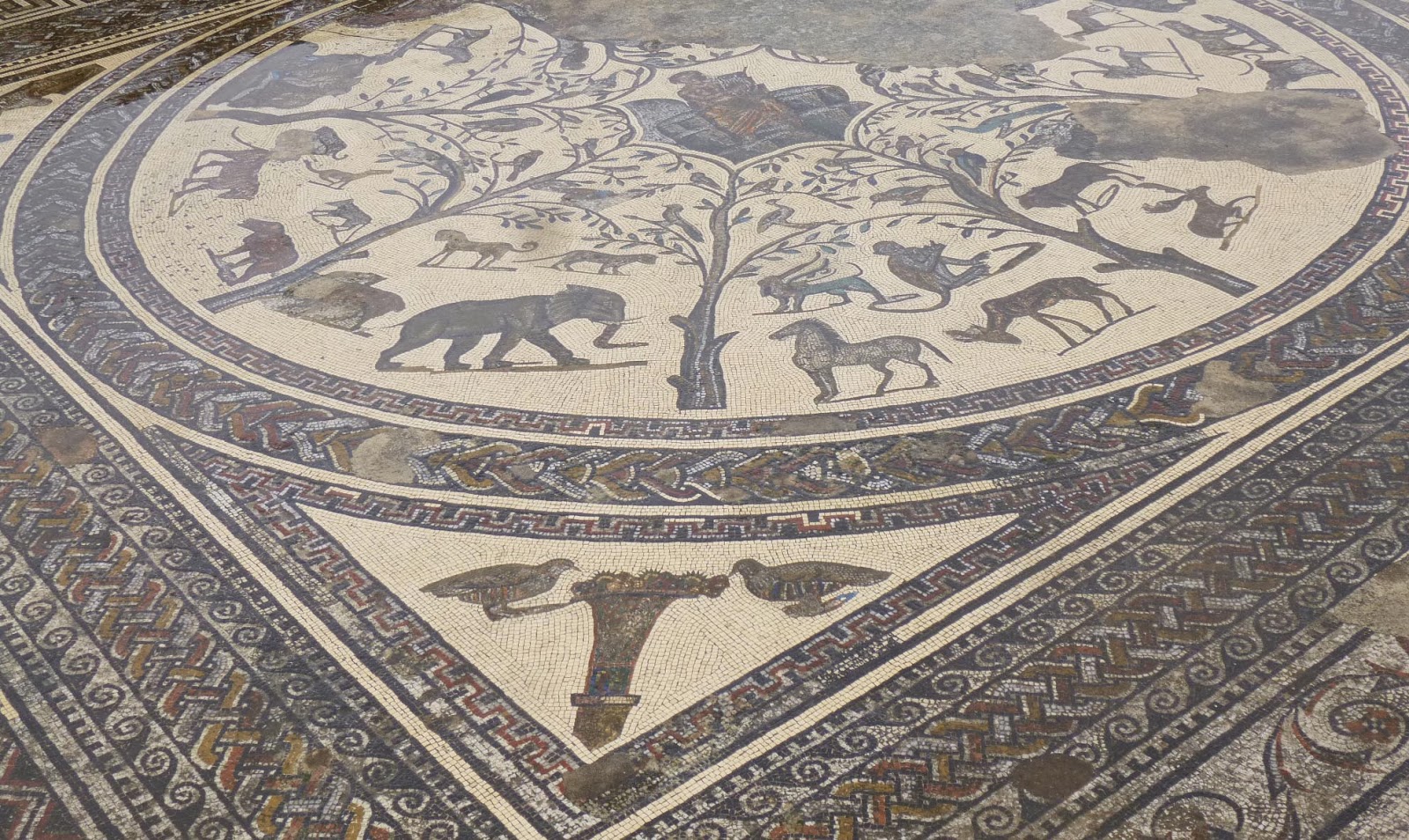
On the second day we visited Volubilis which is a city that is left from when the Romans ruled. 15,000 people lived in Volubilis during the Roman era. In Volubilis we saw mosaics that were 2,000 years old and still intact.  In Meknes (a city near Fez) we went into a former mosque and a granary.  We also saw them pounding silver thread into metal to make jewelry. 


The intricate mosaics, stucco, and wood painting typical of the many mosques we visited.

One of the 2000-yr old floor mosaics at Volubilis
On the third day we drove 7 hours up and over the middle Atlas Mountains which are a mix of steppe meadows and dry forest, which is dominated by oaks, cedars, junipers, and pines. The Atlas Mountains are located in Algeria, Morocco, and Tunisia and are 2,400 miles long.  In the mountains we saw Barbary apes, which were very tame, and I fed some of them (other people were doing it too).  We went through the high steppes that had snow and I was the first person from my family to throw a snowball in Africa. We saw lots of feral sheepdogs along the road; they wait for tourist buses and try to get free food. We followed a desert river where they grow dates.  In Morocco they grow over 25 kinds of dates.

At the end of the day, we got to the edge of the Sahara Desert, where we climbed up some of the smaller dunes which was fun because where I live there are small dunes, but you can’t climb up them. The Sahara Desert takes up 10% of Africa. 25% of the Sahara Desert is dunes, and some dunes can get up to 500 ft. The Sahara Desert is the 3rd largest desert in the world after Antarctica, and the Arctic. The annual rainfall is about 2.5 cm a year.
Barbary ape in Atlas Mountains

Panorama of landscape in Middle Atlas mountains ~2000 m

Panorama of landscape typical east of Atlas Mountains at edge of desert along a riparian oasis.
The next day we went to a small town and heard Berber music. Then we went to the site of old lead mines. After that, we went to a house of a nomad which was by itself in the middle of the desert (see photo). Their house is more like a few tents than an actual house. We played soccer with the nomad kid that lived there. He was 7 years old and doesn’t go to school and doesn’t get to play with other children (besides visitors) because there are only a few other tents nearby and there aren’t any other children.

In the late afternoon we rode camels to a camp in the middle of the dunes. When we got there we climbed up a giant dune to watch the sunset. That night after dinner, we hung out round the fire and we learned how to drum with our Berber hosts. We woke up early in the morning to climb up the dune and watch the sunrise. Then we came back on the camels and drove to first to Todra Gorge and then to Dades Gorge, which are canyons in the desert. Then we walked along the river in Dades Gorge and looked at the crops. The next day we visited old towns and fortresses where they filmed Hollywood movies such as Lawrence of Arabia. 

Playing soccer at nomad house in middle of the desert

Giraffe and Travis on camel ride

Dunes at sunset.  

Travis gets training so he can go play on West Cliff

Ait Benhaddou - one of the many kasbahs (fortresses) from the 10th-14th centuries 
We drove back over the High Atlas Mountains towards Marrakech and saw lots of amazing scenery.  We went over a pass that was 2200 m.  At the bottom we saw how women processed Argon nuts (which are nuts kind of like almonds), to make soaps, lotions, cosmetics, and butter (kind of like peanut butter). Then we arrived in Marrakech where we went to the main square. The main square had lots of different shops and crafts. My dad got a picture with the snake charmers. There were also a lot of orange/lemonade/grape juice stands.

In Marrakesh we visited more mosques and the large market where they sell many things such as, tassels, rugs, magic boxes, spices, and rugs.  We went to a place where they made dyes for wool, cotton, and cactus silk. After that we went to Jardin Majorelle (a garden). The garden had mostly succulent plants in it. The last day we went to a cooking class where we learned how to make Moroccan soup, vegetarian and lamb tagine (the national dish of Morocco, kind of like a casserole), and Moroccan bread. The food was very good.

Total cat count for trip: 129
Total dog count trip: 112
CATS WIN!


Travis (writer), Karen (photos and editor), Michael (maps & birthday boy - March 12)

P.S. If you can't see the details in the photos, you can click on them and they will enlarge.

Travis and Moroccan women shelling and grinding argonne nuts


Michael was very excited to see the snake charmers in Jemaa el Fna (the main square in Marrakech)

Spices in market

Travis models desert wear in front of natural dyes

Moroccan cooking extravaganza

Monday, February 10, 2014

Andorra & Madrid

Dear Family and Friends,

Three weekends ago we went to Andorra. Andorra is a small country wedged between France and Spain. In Andorra you can drive from one end of the country to the other end of the country in 45 minutes. There are no train tracks. There are seven big towns. Andorra is the 16th smallest country in the world.  It is 468 sq. miles and has a population of 85,000 people; Santa Cruz COUNTY is about three times bigger in size and population.  Andorra is in the Pyrenees Mountains. The average elevation of the country is 6,549 feet (just over a mile tall) and ranges from 2,756 feet to 9,652 feet so there are some tall mountains turning into very steep valleys. The scenery was spectacular the second day.  We couldn’t see the mountains the first day because it was snowing, but we saw a rainbow (it was special because it was created between snow and sun) (also because it was a double rainbowJ. What does it mean?! (Inside joke)).

While we were in Andorra we went to a ski resort called Naturlandia. It had a roller coaster /slide (the Tobo-Tronc) which is 3.5 kilometers long (to see it go to the link here). It was so fast. It was so long at the top there was all snow and at the bottom there was almost no snow. We also went zip lining, snow shoeing, cross country skiing, sledding, and snow tubing.

View of the mountains in Andorra
Cross country skiing in Andorra

Last weekend we went to Camp Nou (pronounce no). Camp Nou is where Barcelona Football Club plays. Barcelona has won four UEFA (Union of European Football Associations) League championships, is more than 100 years old, and has at least 150 trophies. They have 173,000 members. The stadium is the second largest soccer stadium in the world. Barcelona FC also has handball, roller hockey, indoor soccer, and basketball.

Camp Nou (Barcelona soccer stadium).  Plant nerds out there...my dad would like you to notice the turf light structures that he wants to get for his next experiment.
This past weekend we went to Madrid and to some surrounding towns. On Friday we took the high speed rail from Barcelona to Madrid. It took us two and a half hours to get there and we stopped at one station along the way. At one point the train was going 300 kilometers per hour (186 mph). Then once we arrived we went to the Royal Palace. The Royal Palace is the official residence of the royal family but is only used for ceremonies. It was built in 1755. In the Royal Palace there was a room where everything was covered in gold. Every many of the royal family has many rooms including a separate room for each person to eat lunch.  There was also an armory that had a gun that was 15 feet long. In the armory there was also armor for children.

Royal Palace
The next day we went to a town north of Madrid called Ávila, which is a town that has a wall all around the city. We got to walk on the wall. We heard a story about one time the army left and an enemy came trying to capture the city so the women took cooking utensils and torches to make noise so that the enemy thought the army was still there. Then later we went to another town called Segovia. In Segovia there was an aqueduct that was built 2000 years ago by the Romans to and is still standing. The romans used the aqueduct to transport water. They didn’t use any mortar to build the aqueduct and it had 167 arches. We also went to the alcazar (fortress) in Segovia where in the olden days they dropped boiling oil on trespassers heads.
Wall around Avila
Aqueduct in Segovia
Armor in Segovia Alcazar

On Sunday we went to Toledo, south of Madrid. Toledo is a town built on a hill for protection. It also has a natural river running around it on 3 sides which was helped with protection from attacks. In Toledo they are known for making swords and there are a lot of sword shops. One shop had a remake of Bilbo Baggins’ sword which cost 188 Euros (~$250).

Travis

View of city of Toledo, Spain (not Ohio)

Window of one of the many sword stores in Toledo

Sunday, January 19, 2014

Sant Cugat, Barcelona, Spain

Dear Friends and Family,

On January 9 we arrived in Spain. We are living in a small apartment in Sant Cugat.  It takes us 20 minutes by train to get to Barcelona unlike when we were in Richmond (Australia) where it took us 1.5 hours to get to Sydney which is nice because it doesn't take so long. Where we live in Spain you can walk a kilometer and do all your shopping and activities, which is unlike when we lived in Australia. There is even a grocery store in our apartment complex.

We are in Catalonia which is a part of Spain. People in Catalonia speak their own language which is Catalan. Many Catalonians want their own country and people fly the flag of Catalonia (the state flag). At my school we have classes in three languages: English, Spanish, and Catalan.  We also have to take another language: French or German.  The other day we had French and I understood absolutely nothing.  I can understand a little bit of Catalan, because it is kind of like Spanish. At my school I met a bunch of people and have made a lot of friends. At my school we play soccer every recess (just like in Australia).  There is also a school soccer team that I am on.  I have to wear a uniform.  We also have to take an instrument.  

Last weekend we went to the Barcelona History Museum. I learned that when Barcelona was first colonized (approximately 10,000 years ago) about half of present day Barcelona was under water. I also learned that the Romans ruled for a long time and they called it Barcina. In the city of Barcina exhibit I learned how they dyed their clothes, where they cleaned themselves and their clothes, how they made fish sauce, how they kept fish, and how they made wine. They made fish sauce by taking the head and the guts and grinding them up. They kept the fish by catching it and then cutting off the head and the guts for the fish sauce. Then they would put the fish in layers of salt and then they put a final layer of salt so the flies couldn't get to the fish.
We also went and saw an organ concert at the Cathedral of Barcelona. The cathedral and the organ were amazing. They started building the Cathedral in 1298 and it took 150 years.  The organ had around 200 pipes (my dad counted) and is over 600 years old. The concert was an hour long. 

Yesterday we went to the Museum of Mammoths. It was quite small but we learned about sabre toothed tigers, prehistoric rhinos, and musk oxen.  Then we went to the Museum of Chocolate. In the Museum of Chocolate I learned about how chocolate is made. I also learned about how the Aztecs used it as money. The Europeans thought that was crazy because the money was growing on trees. There was also a video of how chocolate became so important. There were also some amazing sculptures (see photo below).  Then we went to the Picasso Museum. It was not as interesting as the chocolate museum of course, but it was still interesting.

For those of you who didn’t see me in California I thought you might want to see the pic of me with my dyed hair for the Denver broncos (football team) who are going to win the superbowl :D (Just saying).
            *You must have a google account to comment on the blog*
Travis :) :D

A few comments from Karen: We’re feeling really fortunate at how easily we’ve settled in here and how well things have worked out, particularly on the housing front.  Arranging housing here from Australia last fall was a challenge.  After responding to several online advertisements and either not getting responses or being told that the owners wanted year-long leases, we thought we were going to have to show up here without housing and find something once we arrived.  So, we were quite relieved when a man kindly took pity on us and offered us a 5-month lease since his sister had a similar problem finding a short-term lease in San Francisco; we put down a deposit after only a “skype tour” of the apartment.  We feel quite fortunate that apartment and the location are working out well for us.  The owner left it well furnished so we only had a few household items to find on our “scavenger hunt” of San Cugat last weekend.

San Cugat is a bustling town of 85,000 people (and a lot of dogs) with everything within close walking distance if you know where to find it.  As Travis mentioned, it is 20 min. by train into Barcelona.  It takes 10 min. in the opposite directly by train to get to the Autonomous University of Barcelona where Michael and I are both being hosted by research colleagues who have been very welcoming.  In addition, over the next few months we will be visiting research colleagues elsewhere in Europe.

Before I left, several people asked me if I was preparing for the Castilian accent, since I speak Central American Spanish.  I’m pleased to say that I have had no difficulty understanding people or vice versa, although like with American and Australian English, there are a number of words that are different.  One thing I have been struck by is the dominance of Catalan (the local language) in the region.  It isn’t an issue for talking with people, since everybody speaks both Spanish and Catalan and responds to me in Spanish.  But, nearly everything is written in Catalan (e.g. the pamphlets on the train ticket pass options and bank account types, store signs).  I can usually make out the gist of text since is closely related to Spanish and French, but we’ve definitely been appreciative of the Google translate function.  The Catalonian independentist movement is quite strong, and I was asked twice in my first weekend here to sign a petition to put a referendum for independence on the ballot.  Fortunately, the people at Travis’ school have been quite accommodating in giving him more Spanish and less Catalan instruction, and he seems to be doing quite fine navigating the mix of the Spanish, Catalan, and a little English on the playground.

Saludos,

Karen   
              my mohawk

 my (rooster) mohawk
in Barcelona. gettting lunch on Avenida Las Ramblas

 my school uniform

 the street we live on

San Cugat with the monastery tower in the background

a sculpture at the  Chocolate Museum


Monday, December 2, 2013

Sydney and the Snowy Mountains

Dear Friends and Family,

          Three weeks ago we went to the most well-known landmark of Sydney, the Opera House. We had some troubles getting there because there was track work and the trains were not running for about half the way we had to go. We had to ride a bus to where the trains were running and then catch a train to Sydney – it was very slow!  Once we got to Sydney, we walked around the Royal Botanical Gardens. We saw lots of cacti to my dad’s delight. After going to the Royal Botanical Gardens we went to the Sydney Opera House for a tour which was very interesting. One thing I learned is that the roof weighs 160,000 tonnes (four times the weight of the Sydney Bridge) and there is not one support beam in the whole Opera House. Another thing I learned is that in one of the theatres the organ has 1,200 pipes. After the Opera House tour we went to an aboriginal art show. At the art show there was a man making a painting by doing dots. He told us that he has to get up after about 2 hours because he starts to see stuff. After the art show we went on top of the Sydney Harbor Bridge. It was very cold and windy on top of the bridge.

Sydney Opera House and Bridge in background

The next weekend we went to the Sydney Aquarium. We got to the aquarium by taking the train half way there and then we took the ferry the rest of the way so we got a great view of the Sydney Harbor and Bridge.  We went to the dugong talk. A dugong looks like a manatee except it is smaller, it’s only found in the southern hemisphere, and its tail is more like a whale’s tail. One dugong consumes 40-50 kilos of lettuce a day. The keepers sink one tray of 12 heads of lettuce every 15 minutes from 7 am to 8 pm for the dugongs (see one of the dugong’s eating at http://www.youtube.com/watch?v=JBAcBCUGmKY) . In the enclosure there were also sting rays (click http://www.youtube.com/watch?v=Nu2fOoGy2Fs  to see one swimming). I learned that there are 600 species of sting rays in the world. I also learned that crabs have tooth-like structures in their stomachs. Japanese crabs can grow up to 3.8 meters long from claw to claw. They can also live up to 100 years of age.
Since we didn't send any photos of the Great Barrier Reef you'll have to settle for my mom's reef aquarium photo instead.  Below is the "dugong diner"


This past weekend we went to the parliament house in and we also hiked the tallest mountain in Australia. We went on a tour a of parliament house which is in Canberra in Australian Capital Territory (like Washington, DC in the US).  I learned that the parliament house has 4,500 rooms and has 2,500 clocks. I thought that was amazing. All the clocks go off for four minutes when parliament is about to vote.

On Saturday we hiked up Mt. Kosciuszko which is the tallest mountain in Australia (2228 m high which is lower than the town of Mammoth) and is in the Snowy Mountains on the border of New South Wales and Victoria. At one point I was the highest person in Australia. There was enough snow to have a snowball fight. My mom and dad used Australia’s highest elevation bathroom. After the hike we went to Australia’s highest restaurant and had a drink. Then we went bobsledding on a track, not on actual snow. There was only snow near the summit. Then we took my mom out to dinner since it was her birthday. On Sunday we went hiking again. When we were hiking there were a lot of flies which was very annoying. After hiking we went bobsledding again. It was a lot of fun because you could go really fast. 
Highest kid and stuffed giraffe in Australia - top of Mt. Kosciuszko

Alpine hike in the Snowy Mountains
We will be coming home in a couple of weeks and might see some of you. That also means this is the last blog from Australia. L


Travis ;) :D :p

Wednesday, November 13, 2013

Claymation and more

Dear Family and Friends,

               We are happy to say that the fires are over and it has rained so we can breathe now.  

Above on left is our friend David's house that I mentioned in the last blog and on right is the woods that burned.  Below is what most of the Blue Mountains look like now.  The fire fighters did an amazing job, as there were houses surrounded by forest on three sides that didn't burn.


               Two weeks ago we went hiking (again?!). On the hike there were many cicadas, which were very annoying because they were loud. We found out later that cicadas can get up 120 decibels. The trail was flat for about 1 mile and then we went down 900 feet in a matter of about 700 feet. It was very steep, and we were hiking on a small ledge so it was quite scary (see photo). We got to see a waterfall from the top and a view of the Blue Mountains and then we hiked down to the bottom of the waterfall. It was like mist once we got to the bottom.

Wentworth Falls (original photo copyright Robert James, our approximate path added in red by Karen)

Photo of some of the many stairs we walked down.  Copyright Tripadvisor - no, we weren't taking pictures while walking down here.

We survived.

One of the many lizards I spotted.
                Last week we did Claymation on Monday in my class. It sounded really hard, but it was really easy. At the beginning we had to make our characters/set. I made a James Bond movie. The hardest part was making a jet for my James Bond. Then the person who came had some cameras that didn’t move so all I had to do was move the scene a little bit and take another picture. The man also brought computers that put the pictures together for us. Then we had to add sounds, which was a little harder since you couldn’t control how long they ran. But overall it was one of the most fun things I’ve done in school in Australia. Here is a link to my Claymation video on YouTube. Remember to give it a like. http://www.youtube.com/watch?v=BSum6m0dfkM
               
                Last Sunday we took the train to Sydney, which takes about 1.5 hours each way. We went to the National Museum of Australia where we saw lots stuff associated with Australian history. My favorite thing was an Aboriginal artist who had made an emu out of barbed wire and rebar.  Barbed wire kills them a lot of the time. My other favorite thing there was a wooden snake that was 4 feet long, also made by an Aboriginal artist. It was quite amazing. I also saw some stunning photos of bugs. They had photos of them hanging upside down and there was a photo of a bee buzz pollinating plants where you could see the pollen. After going to the National Museum of Australia we went and saw Grease, the musical version.  

               Travis       


Sunday, October 27, 2013

Life in smoky New South Wales

Life in Smoky New South Wales

Dear Family and Friends,

Three weeks ago we went to Newcastle which is about 2 hours away and north up the coast from Sydney. We went hiking there. In the night we saw flying foxes (bats) they were huge and we saw thousands of them leaving their mangrove forest home for a night of eating fruit and nectar. I’m not exaggerating. The next day we went hiking again. We saw tadpoles (I caught one), 2 pythons, a tree monitor (lizard), and a crayfish (which scared me).

Barrington Tops NP


Crayfish, note the eggs on the underside of the tail.


Python


Tree monitor lizard


Two weekends ago we went to Manly (a suburb of Sydney next to the beach). We went hiking (again). Then we went to the beach where I found a lot of shells. The next day we went to the beach. Then we went hiking (do we ever do anything else? Yes).

Last weekend my dad and I went to a model park run by the Sydney Society of Model Engineers.  It has been a club for over 100 years. It was a lot of fun; it had HO model trains, ride-on trains (not full size regular trains, but small ones), slot cars, a garden railway, RC planes, RC boats, and RC cars. We rode on the ride-on train. We watched the large RC cars that are about 1.5 feet long (which sounded like motocross if you’ve been to motocross, that is). We also raced the slot cars. That was a lot of fun!

There have been fires near us (apparently they reached U.S. headlines. WOW.). We are ok. There are lots of fires which means there is a lot of SMOKE (very annoying). The fires started almost two weeks ago.  My dad's friend David Tissue lives right near where it started. Because the winds kept changing direction, the fire burned past his house 4 TIMES!!! Each time burning in vegetation that was unburned the previous times.  Not only had that happen but the fire started 2 houses down from his house. :o . Also the fire fighters are staying in the dorms near us and they have taken the field on which I play soccer and football (NO!). The local media has stopped covering the fires because the immediate danger is lower now, but it may take six weeks to get them fully under control.  That is unless the winds pick up again.  My school has been doing a goods drive for the firefighters and we donated some items today.

Travis

Firefighter encampment in front of our house
Quick note from Karen - I'm just back from giving seminars on my tropical forest restoration research at James Cook University and the University of Queensland.  At UQ, my host, Margie Mayfield, organized a mini-symposium of rain forest researchers so I also had the opportunity to hear about the work of other graduate students and faculty there who work on tropical forests in Australia and the Philippines.  I spent Saturday in Brisbane where I went hiking with a researcher there, John Dwyer (Travis wasn't with me so he didn't have to hike and listen to nerdy plant discussions) and then rode the boat that runs down the Brisbane River which runs through the heart of the city; people actually commute by boat there.  We'll now all be in Richmond for the rest of our stay except for some short weekend outings.

View of Brisbane from the boat


Friday, October 11, 2013

Home, Sweet (Temporary) Home in Richmond, New South Wales

Dear Family and Friends,

We are finally settled in to our house and done traveling (for now). Our house is a small house that has a living room/dining room, three bedrooms, two bathrooms, and a kitchen. My room is already messy but that is because it is small and my room at home is usually messy as some of you may know. We have a huge lawn in front of our house which is awesome so I can play football and soccer on it. In back we also have a lawn but not as big. Our house is on the University of Western Sydney, Hawkesbury Campus, but we have hardly seen any students. It’s only 100 ft to the green houses were my dad is working.

The school and town is about half a mile away. It’s a small town about the size of Felton (or maybe more like Scotts Valley), but it is much flatter. It is spring here now (because we are in the southern hemisphere and the seasons are reversed), so it’s green outside and very warm.

Last weekend we went to the beach which was fun because we went in the water and I watched a lot of planes land since the beach is near the airport.

On Wednesday I went to my first day of school which was really fun. I met a lot of people which was good and we played soccer and I got a goooooooooooooooooooooool! (I spelled that in Spanish on purpose). We were in class and a giant army plane was landing and was only 50 feet above the 2 story school, because there is an army base nearby.  Lots of kids wanted to talk to me because I am from the U.S. I have to wear a uniform (not too bad - grey shorts, blue polo shirt, and a blue hat for outside activities). The school pretty much the same as mine in the US but they have 1 hour 15 minutes of recess which is awesome! But they have announcements after every recess. At my school here they like to play foursquare and minecraft just like at home.
Travis and friends in Friday P.E. school uniforms 


Richmond Public School 

The front of our house

The living room

Magpie near our house - lots of birds around here that call out often - especially the kookaburras

A few musings from Karen: We’re now settled on the University of Western Sydney, Hawkesbury Campus which is 50 km west of Sydney and is in what feels like a relatively rural area.  Michael is working with his collaborator David Tissue, on various global change experiments (more from Michael on that below).  In the meantime, I am commuting 2 meters across the hall from our bedroom to my computer, where I am working on various writing projects largely free from the many interruptions of when I was department chair for the past three years.

We are staying at a visiting faculty house right on the campus, which is quite nice (and not quite as small as Travis suggests).  When I arrived on a Sunday night, I was a bit concerned that our house was right in the middle of campus with two dorms I can see from my office window.  But, in the past week I could count on my hand how many people have actually passed the window each day, leading me to wonder where all the students on the campus are.  David has told us that the two dorms in view are currently unoccupied and being renovated, partially explaining our unexpected and much appreciated privacy.  But, even on a bike ride to the other side of campus I still saw very few students.  David tells me it’s because this campus (University of Western Sydney has about five campuses) was actually going to be closed down, but they decided to invest heavily in their Environmental Institute here so it’s more of a research institute than a campus; indeed, the only other subjects that seem to be taught here are nursing and criminal science.  It means that I feel like our house is a mile down a country road, rather than on a college campus.  We do have some nice neighbors in the house next door, who are coincidentally from Spain (where we’re headed in the winter/spring), but otherwise we don’t see many people.

There’s a shuttle bus between campus and town (about 1 km away) with a whopping four stops – the campus library, campus residential, the mall in town, and the train station (Travis’ school is about half way between the two) so even I can’t get lost.  We are at the end of a train line to Sydney so we do plan to make some weekend trips there, as well as hiking in the Blue Mountains to our east.  But, otherwise, I’ll be typing away and enjoying the lack of distractions.

The field in front our house - note that it is always this empty.

And, now, Michael’s turn:  We’re now down to my science portion of our sabbatical.  It is common for scientists to go visit a host lab when they are on sabbatical. My host here is Prof. David Tissue, whom Karen mentioned above.  David and I have been friends and colleagues since the mid 1980s.  We were graduate students in the same lab at UCLA, and for the past 15 years or so have collaborated on research on desert plants (in Big Bend National Park, TX, and in Mammoth Lakes, CA among other places) and vegetation responses to rainfall patterns and climate change.  Seven years ago, David moved from Texas Tech University in Lubbock, TX to the Hawkesbury Institute for the Environment at the University of Western Sydney, Hawkesbury Campus.  He is one of the lead scientists on a massive research project on how plant physiology and forest ecosystems are affected by various aspects of climate change.  They have a variety of amazing climate experiments in place, which are highlighted in the photos below.  To a climate/plant/electronics/weather nerd like me, this place is Scientific Disneyland.  While here, I will be part of a multi-university team that will be investigating how a large number of “genotypes” (individuals of one species, but varying in their genetic composition) of Eucalyptus respond to elevated conditions of carbon dioxide (remember that Eucalyptus - all 700+ species - are native to AU). I will also conduct a smaller-scale project on how future climate conditions affect tree survival of heat waves (which are expected to get more common in the future.) OK, so that’s the science plan, now on with the photo show....

There are many state-of-the-art greenhouses here in which Michael will be working.  They are designed to grow plants under fully controlled conditions of watering, temperature, relative humidity, and carbon dioxide concentrations.

There are called "Whole Tree Chambers" (not rocket-trees!)  They contain entire trees, and the internal air has precise temperature, humidity and CO2 concentration controls. The roots are isolated from the upper parts of the tree so that photosynthesis can be measured separately from respiration from the soil.

Not the best photo, but I wanted to give a sense of what it looks like inside.  Ladders allow access to all parts of the tree.


These are called Rain Out Shelters, though they look somewhat post-apocalyptic. There are no others like these in the world. When it rains on a sensor, motors automatically lift transparent plastic curtains up along the sides and down the sloped tops, preventing rain from getting to the plants inside.  Currently, plants are in pots but the next experiment will have entire trees planted inside these shelters.


This is another rain out shelter experiment.  These are obviously smaller and do not move in comparison to the big fancy ones in the previous two photos.  Water runs off the top and a series of pumps add 50% more or 50% less water to the soil under the shelters, compared to the actual amount of natural rainfall. All kinds of measurements are being made in these research plots, including which species like the altered rainfall, how much they grow, what insects visit, what is happening in the soil, etc.


Distant view of "EucFACE" where carbon dioxide is being continuously added to the Eucalyptus forest to better understand forest ecology under future conditions.  There are several large research plots, each about 25 m across.  The construction cranes allow researchers to be lowered in buckets for measurements anywhere into each of the research plots, to any height above the ground (the forest is about 20 m tall.)  I have not yet taken this Disneyland ride.


Best wishes from Travis, Karen & Michael!